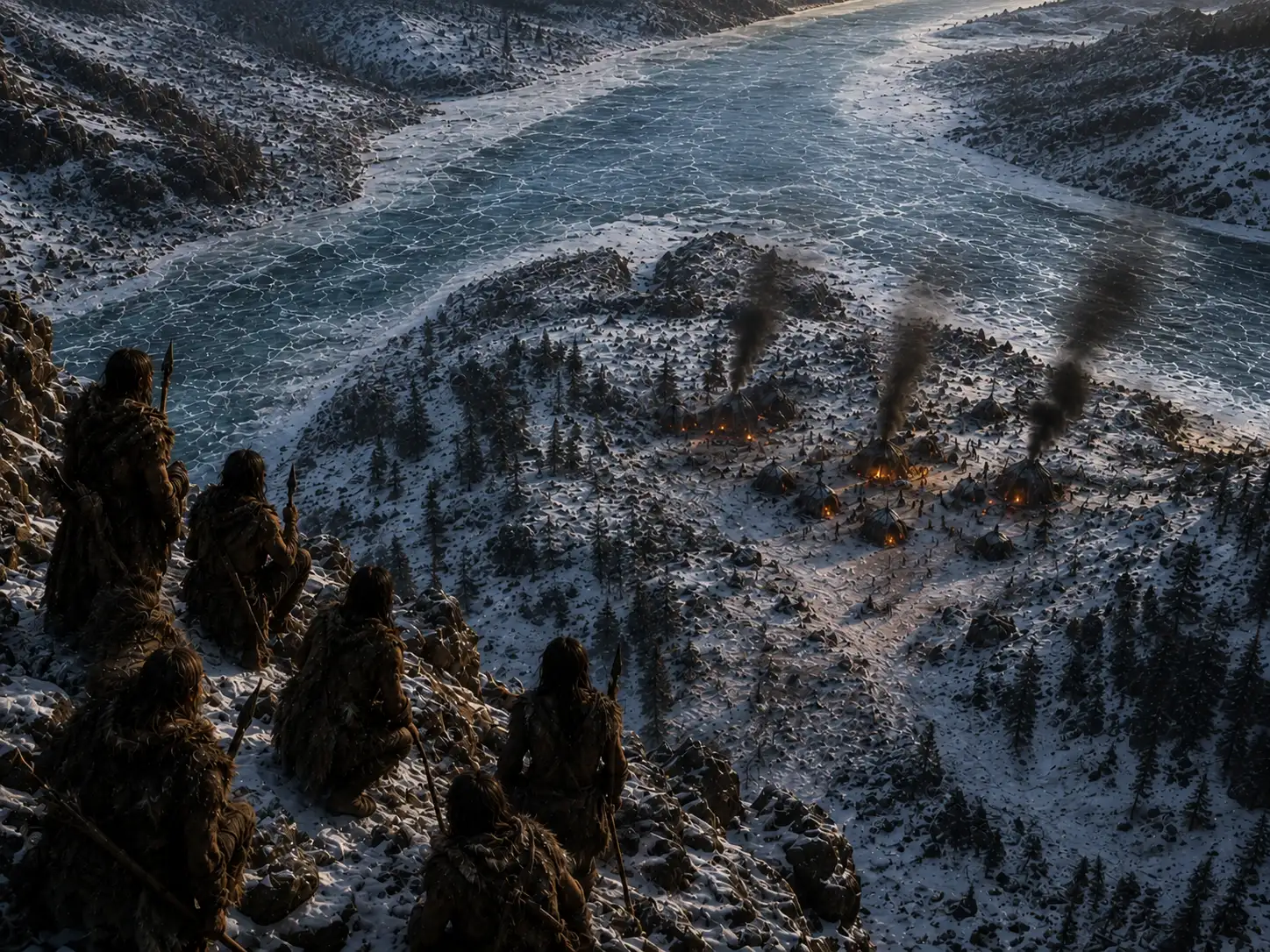
Since Oruk fell silent, the valley had seen as many springs as there were fingers on two hands combined, yet never one so late and hesitant. In those winters, many old faces had disappeared beneath the snow, while those who remained had grown thinner and quieter, their bodies slowly bending beneath the weight of seasons they had once believed would never end.
The snow had not fully disappeared. It retreated in patches, first from the southern slopes where the sun lingered longest, then from the hollows between the rocks, and finally from the wide grasslands beyond the frozen river. For weeks, the valley existed between two seasons. The mornings still belonged to winter, hard and white beneath the feet, while the afternoons smelled of thawing earth, wet moss, and the first green shoots pushing stubbornly through the cold.
Tarek was no longer the boy who had stood beside the frozen river with Oruk’s broken spear. His shoulders had broadened, his limbs had hardened, and years of climbing ridges, crossing rivers and following tracks had taught his body to move before he thought. He could read rain in the smell of the wind, distinguish a wolf from a fox by a single print, and find water beneath ground that looked dead. The small hide of his childhood had long since disappeared. Around his waist, he now wore a larger skin, patched at the edges and softened by years of use, while a weathered fur rested across his shoulders against the cold. Sometimes a young woman shared his sleeping hide; sometimes she did not, and neither asked what the next season might bring. Children belong to their mothers and to the whole group, and sleeping places changed as easily as the river changed its course.
The group had given him everything he needed to grow: food when he was hungry, hides when the cold came, a place beside the fire, and work enough to make his hands strong.
Yet there was one thing they still refused to give him.
The hunt.
When the hunting party left the camp, he was sent in the opposite direction with women and children carrying gathering sacks.
The elders always found another reason.
“You guard the berry-pickers.”
“The children listen to you.”
“We need hunters in camp, too.”
“Next season.”
Always next season.
At first, he accepted it. Then he protested. Eventually, he had learned to stay silent. The answer never changed.
That morning was no different. The hunters had departed before sunrise. Somewhere beyond the valley, they were digging new pits for prey, widening the old traps and preparing for the animals that would return with the spring. Around the fire, however, the valley told a different story. Many of the faces that had once gathered there had disappeared into the snow over the years, their places left empty beside the flames. Yet the emptiness had never lasted. New faces had appeared, first as sleeping infants carried against their mothers’ bodies, then as restless children, and finally as young hunters and gatherers taking their place among the living. The fire had lost many faces, but it had never lost its people.
Tarek watched the hunters disappear into the pale mist.
Punto walked among them. So did Sela. Both were his age. Both had begun hunting several winters earlier. Even little Enu had grown and joined them last winter. They carried themselves with the easy confidence of those who had already learned where to place their feet, how to read a broken twig, and when to let the wind speak before they did.
Punto glanced back once and raised his spear with a grin, “Try not to frighten the berry bushes.”
Sela shouted, “If the murderer mushrooms attack, shout my name.”
They hunted. Tarek gathered roots. They tracked the great herds while he searched for medicinal leaves and berry thickets. They returned with blood on their hands. He returned with mushrooms and berries. He knew they needed gatherers as surely as they needed hunters. He knew every child had to learn both. But knowledge did not make frustration disappear.
The cranes had already returned from the east, their calls carrying across the valley like distant bells. But everyone was waiting for the mammoths to return. Tarek was waiting for them, too. But not with the hunters. He stood among five women and four children, carrying sacks.
He was the only one among them with a full hunting spear. Not because they expected trouble, but because trouble rarely announced itself.
Tava, Kiha’s eldest daughter and the oldest of the gatherers, carried a digging stick polished smooth by decades of use. Two younger women carried leather sacks across their backs. The children scattered ahead, chasing one another through the grass despite repeated warnings not to wander too far.
One of the youngest children skipped ahead before anyone could stop him. His name was Naru, a curious boy who had survived only a winter less than the total fingers, but possessed the dangerous confidence of someone whose courage had not yet met consequence. He had developed the unfortunate habit of following Tarek everywhere.
He fell into step beside Tarek almost at once.
Naru asked, “Is it true?”
Tarek sighed, “What?”
“The baby mammoth, you helped, never came back?”
Tarek stopped. Naru stopped too. Tarek stared at him. Naru raised his brows twice. Tarek sighed, shook his head, and they continued walking.
The gathering party moved toward the southern edge of the valley, where the snow had melted first. Women searched beneath shrubs for edible roots while the children collected fallen branches and berries.
Tarek tried to concentrate. He truly did. But Naru had questions. Many questions, with no end to them.
“How did you kill a sabretooth?”
Tarek did not answer.
“My mother says you didn’t.”
Still nothing.
She said, “A twig can’t kill a cat.”
Tarek’s jaw tightened, “It was not a twig.”
Naru studied him, “It was a twig. Everyone says that.”
Tarek frowned.
Naru continued, “Why did you use a twig for your spear shaft?”
Tarek sighed. “Because I thought that, by the time I grew up, the twig would grow too and become stronger. Now shut up and gather.”
“What a mammoth-brain!”
Tarek caught him by the ear.
“Ow!”
“Gather.”
“I’m gathering.”
“You’re talking.”
“I’m gathering knowledge.”
Tarek gave his ears a gentle twist.
“I can do both,” Naru repeated, more carefully.
Tarek released him and walked ahead.
Naru plucked every berry from a bush the elders had left untouched. When his sack was full, he lifted it proudly.
“I don’t know why everyone insists on working hard when you can work smart.”
Tarek glanced at the basket. He took a single berry, turned it between his fingers, and smelled it. Then he threw it into the snow.
Naru’s smile faded.
Tarek looked at the bush, then at the sack, and said, “The elders left them for a reason.”
He tipped Naru’s sack over, spilling the berries into the snow, and walked on.
But they looked so tasty.'' Naru stared at the pile and asked,Besides how do they know?”Tarek gave him a long look, “Because their elders told them so. Poison needs to look tasty. In fact, too tasty. That is how it works.”
Naru frowned.
Tarek walked on, “Gather what you know. Gather the sticks and moss.”
Ignoring him, Naru asked, “How did the elders’ elder know about the berries?”
“Their elders told them.”
“And how do they know?”
Before Tarek could reply, a voice came from behind.
“There was a time when mammoths could talk. They told them.” Tava replied, having overheard him.
Naru frowned. “Why don’t they talk any more?”
“They do… We just don’t understand them any more,” replied Tava.
Naru hurried after Tarek. “Did your calf talk to you? Did Oruk understand them, too? Is that why you went to save it?”
“I don’t know.”
“Did Haruk know how to talk to a mammoth?”
“I don’t know.”
“Why did Oruk want to go beyond the mountain?”
“I don’t know.”
“Did he ever go?”
Tarek finally turned, “No.”
“Why?”
“Because he died.”
Naru stared at him. Then he asked quietly, “Would you go?”
Tarek opened his mouth. Nothing came out. He looked away.
The tundra stretched before them.
The grass was still brown from winter, but green shoots were beginning to appear between the old stalks. Meltwater gathered in shallow pools where insects had already begun to return. The air smelled different from winter. It carried dampness now. Life.
A little farther on, they spotted a fox creeping through the grass. Something small darted ahead of it, disappearing beneath the earth before the fox could pounce. The fox froze, listened, then sprang as the creature burst from another hole. It chased the large mouse across the grass, both vanishing between the reeds while Naru watched, delighted.
Tarek walked on.
Naru followed close behind, kicking aside tufts of frost, and then asked, “How many giants were living in our caves?”
“Not many.”
“Why don’t you ever sleep in the cave?”
Tarek said nothing.
After a few steps, he asked, “Why do you sometimes sleep beside the girls?”
Tarek slowed, then looked down at him and said, “You ask too many questions.”
Naru lowered his eyes, disappointed. Then, after a few steps, he looked up again and said, “Can I ask one more?”
They crossed a meadow where fresh shoots covered the ground like green fur. The women spread apart, digging roots with long wooden sticks while the children searched for bird nests among the reeds.
Tava called without looking up, “Keep your eyes open.”
“For what?” asked Naru.
“Everything!”
That was how gathering worked. Food never announced itself. You noticed broken grass. Fresh leaves. The hum of insects. The places where birds circled. Nature whispered before it spoke.
Tarek wandered a little farther from the others. Gathering had never suited him.
Plants stayed exactly where they were. Animals made choices. Choices left signs. Signs told stories. The earth beneath his feet always seemed more interesting than the plants growing from it.
He crouched beside a muddy patch.
Hoofprints. Less than a day old. Reindeer. Nearby, fox tracks crossed them. Then bird prints.
Spring was writing over winter.
He smiled.
Behind him came Naru again, asking: “What are you smiling at?”
“Stories.”
The boy frowned, “Stories! In a dried patch of mud?”
Tarek pointed, “These crossed yesterday.”
“The deer?”
“Yes.”
“And these?”
“The fox.”
Between exchange of words and wisdom, their feet gradually carried them onto a low ridge overlooking the tundra.
The wind was stronger here. The great grasslands shimmered beneath the afternoon sun. Beyond them lay scattered patches of pine forest, then rolling hills fading into the blue silhouette of the eastern mountains.
Those mountains. He found himself staring at them again, as always.
Naru climbed beside him, breathing hard. They stood together while the wind brushed across the tall grass.
A hawk circled overhead. Far away, a herd of reindeer moved like drifting shadows. Everything felt ordinary. Then something changed.
Not the wind.
Not the birds.
The horizon.
Tarek narrowed his eyes. Far beyond the tundra, near the eastern horizon and before the mountains, a thin dark column rose into the pale sky.
At first, he thought it was another cloud. Except clouds moved. This did not.
The thin dark column rose above the distant tundra, climbing steadily into the sky before spreading into a broad grey crown.
Smoke.
Too much smoke.
Too straight.
Too deliberate.
Tarek followed Naru’s gaze.
Lightning sometimes started fires. But not like this. Not in open grassland. Not after yesterday’s snowfall.
Tava noticed them standing motionless.
She climbed toward the ridge and asked, “What have you found?”
Naru pointed silently.
She looked. The colour drained from her face. One by one, the others climbed up the ridge.
No one spoke.
The smoke continued climbing into the still afternoon sky.
“Perhaps forest fire!” whispered one woman.
Tava shook her head slowly, “There were no storms.”
The column remained. Steady. Unbroken.
One of the children squinted at it, “Maybe the clouds need a walking stick.”
Naru snorted, “Clouds don’t walk, mammoth-brain. They float.”
One of the older girls looked toward Tava, “Are there others?”
“Others?” asked another child.
Naru eyes widened, “Other mammoths?”
Tava shook her head, “Other people.”
“There are other people?”
For as long as anyone remembered, they had believed themselves alone in the valley. Haruk had spoken of distant giants and forgotten people, but those were stories carried beside the fireplace.
Tarek’s thoughts raced: Who were they? Hunters? Enemies? Travellers? Had they crossed the mountains? Or had they always lived beyond them? The questions came faster than the answers.
Tava was already gathering the children, “We’re going home.”
They walked back much faster than they had come. Sacks remained half-filled. No one complained. No one laughed. No one chased birds. Even Naru had fallen silent, his questions forgotten beneath the dark column still rising beyond the tundra.
Every few moments, Tarek looked over his shoulder. The smoke remained above the eastern horizon.
Waiting.
Even at their fastest pace, they reached the cave only as evening settled over the valley. The hunters had still not returned.
The elders gathered immediately as Tava described what they had seen. Several frowned. One old hunter dismissed it with a snort.
“You saw mist.”
“We know the difference,” Tava replied sharply.
“I saw it.” Another woman nodded.
“So did I.”
“So did all of us.”
The laughter faded. The elders exchanged uneasy glances.
Smoke meant fire. Fire meant others. And others could mean danger, strangers, or something the valley had never known before. Whatever waited beyond the eastern horizon, the elders agreed that it could not simply be ignored.
Finally, Kiha spoke, who could no longer walk or see, “If there are others in the valley…”
She never finished the sentence. She did not need to.
When the hunting party returned before sunset, they found the camp already waiting.
That night, the fire burned longer than usual.
Voices rose. Some feared strangers. Others dismissed the smoke as a forest fire. Some argued that no one should leave until the mammoths arrived. Others argued that waiting was more dangerous than knowing.
At last, the oldest hunter rose, his spine bent by winters, and said, “We send far-eyes.”
Before he had finished speaking, Tarek was already on his feet, “I’ll go.”
He had spent ten winters wondering what lay beyond the mountains. Now the land itself seemed to be asking him to find out.
A murmur spread through the camp.
Punto rose next, “So will I.”
He glanced at Tarek and continued, “Someone should make sure you don’t steal all the glory for yourself.”
Sela stood and tightened the sinew around her spear. “I’m coming.”
She had spent enough seasons proving she could follow an animal. She wanted to know if she could follow a mystery.
Enu, the swiftest tracker in the group, quietly picked up her spear, `Then count me as well.”
She had noticed danger before anyone else noticed the sign for it. If someone had made that fire, she wanted to know why.
Tava surprised everyone by standing. “If there are people beyond the ridge, someone should speak before someone throws a spear.”
She glanced around the fire. “Hunting is not the only thing a stranger can understand.”
Even Naru jumped excitedly, “I’ll go too!”
Tava rested a hand on the boy’s shoulder, “Too young to be a trail-seeker. Your mother won’t let you, boy.”
Naru folded his arms. “What if we don’t let her know?”
Before Tava could answer, his mother’s voice tore across the camp.
“NARU!”
Naru’s eyes widened. He turned and bolted into the cave. The camp erupted in laughter.
The elders looked around the fire.
Five faces. Five different reasons. One unknown horizon.
That night, after the camp had quieted and the fire had sunk to a red glow, Tarek sat alone at the edge of the cliff, watching the eastern mountains beneath the stars. For the first time in many years, the unknown was no longer only a dream. It was waiting.
Teya approached with the soft clicking sound of tiny bones threaded into her hair. She smiled faintly before lowering herself beside him, her shoulder brushing his. A strip of sinew held her dark, tangled hair away from her face, though loose strands kept blowing across it. When the wind strengthened, she pulled the small fur from her shoulder and wrapped it around herself. For a while, they listened to the wind moving through the grass.
Then she asked softly, “You never look at me that way.”
Tarek frowned. “What way?”
She nodded toward the mountains, “The way you look at them.”
Tarek glanced at her, caught between a smile and something he could not name. As the fur shifted, he noticed the faint scar crossing one knee, a pale mark against weathered skin.
“The mountains never turned away when I looked at them.”
Teya smiled and rested her head against his shoulder and whispered, “Perhaps you never gave me a chance.”
“Tomorrow you go chasing the trails,” she whispered.
“Yes.”
“Then tonight, at least, look at me.”
Tarek turned toward her then, properly, and for once, the mountain could wait.
The next morning, before the sun cleared the eastern ridge, they were already on the trail.
Tarek carried his spear. Punto carried two. Sela had tied a small hide pouch around her waist, while Enu carried the water-skin and a stone axe. Tava walked behind them with a bundle of dried roots and strips of meat.
The elders had given them three days. Three days to discover who had made the smoke. Three days to return.
No one spoke much during the first hour. The valley gradually disappeared behind them, swallowed by low ridges and patches of young willow. The familiar paths ended. Beyond them lay a land none of them had travelled in years, perhaps ever.
Tarek felt something awaken inside him. For the first time since Oruk’s death, he was not being told to stay behind. He was walking east. The thought made him smile.
Punto noticed and asked, “Why are you grinning?”
Tarek said nothing and quickly composed his face.
“He has been waiting winters for this,” said Sela.
Tarek kept walking, his eyes fixed on the eastern horizon. The others followed.
By midday, they reached the first stream and crossed it one by one, stepping carefully across the cold stones as the water rushed around their ankles. Beyond it, the land became unfamiliar. The tundra stretched between low hills, interrupted by shallow streams swollen with melting snow. They followed the old mammoth trails whenever they could. The great animals had travelled these lands for generations, leaving shallow depressions through the grass where their enormous feet had pressed the earth. In spring, meltwater collected in those depressions, turning them into narrow streams.
They stopped beside a stream to drink and refill their sacks.
Enu crouched and studied the mud, “Someone crossed here.”
Sela knelt beside her, “Animal?”
Enu could not link the footprint with anyone. It was hard to distinguish, as the impression was shallow and partly filled with water.
They followed the tracks for a while, but the trail disappeared where the ground became stony.
They continued east. By afternoon, the wind had grown fierce, breaking apart the smoke before it could gather into a column. They had been walking for half a day, yet the eastern horizon remained stubbornly empty.
Tarek stopped on a low ridge and shaded his eyes.
Nothing.
Only pale grass, dark stone, pale sky, and the distant line of the mountains.
Sela came up beside him, “Are you sure we’re in the right direction?”
Tarek shook his head.
Punto laughed behind them, “Perhaps the smoke was another one of Tarek’s stories.”
Tava turned, “It was there, yesterday.”
“Of course it was,” Punto said. “Just like the big cat’s tooth hanging from his neck. Funny how easily a man’s stories grow teeth of their own.”
Enu chuckled. So did Sela.
Tarek looked east again, his eyes searching for the mountains.
Unlike tales, which grew taller with every telling, jokes grew smaller with every retelling. By then, Tarek’s story had been told so many ways that none of them mattered any more. First, he had killed the sabretooth. Then, he had merely helped kill it. Then Oruk had done most of the work. The story changed with every mouth that carried it.
Tarek knew he had once been the lucky boy. He had never asked for glory, yet somehow they had carved ridicule into his name instead.
Years of torment and mockery had taught him the value of stillness. When the tormentors prodded and jeered, he gave them nothing— not a flinch, not a frown, not a fist clenched tight, not a flicker of fright, nor a tremor of wrath. His face remained as still as a stone lying deep beneath the dark water of a puddle.
Pain was demanded, and pain was denied.
Punto’s smile lingered for a moment, waiting for the reaction that never came. Slowly, it faltered.
By late afternoon, the tundra had begun to change. The open grassland gave way to scattered willow and low, twisted trees growing between the ridges, their branches bent by years of wind and frost.
Enu slowed and lowered her gaze, studying the earth where the soft ground held the marks of passing animals. Deep, round impressions crossed the soft earth and disappeared between the trees, each print pressed heavily into the earth. She followed them with her eyes until she noticed that several trunks ahead had been rubbed smooth on one side, their bark stripped away in broad, rough patches.
Tava crouched beside one and touched the exposed wood, then pulled her fingers back when a few coarse brown hairs caught against them. No one spoke. They all knew that whatever had passed through the trees had been large, heavy, and close.
Tarek touched the hair. It was thick and stiff.
“Something very large and heavy”
Beside them lay several dark mounds scattered among the trees, some frozen hard by the cold, others still fresh enough to retain their shape. Enu crouched beside one, studied it for a moment, and looked toward the trail disappearing between the trees.
“Dung.”
Tava straightened slowly and scanned the woods, “Whatever made it is close.”
Punto tightened his grip on his spear and asked, “How close?”
The rubbed trunks appeared again farther ahead, and so did the dung, scattered more densely now across the soft ground. More tracks crossed one another along the same narrow passage, some fresh enough for their smell to remain sharp.
Tarek followed the marks with his eyes until the truth settled over him. They had not simply found an animal’s trail. They had walked into its path. He slowly raised his head and tasted the wind, and this time the smell reached him clearly, thick with wet earth, fur, and something warm and musky beneath it.
Then Enu pointed ahead, “What is that?”
Something large lay beneath the trees.
At first, Tarek thought it was a fallen trunk, half-buried beneath the snow. Its back was covered in white, and its broad shape disappeared into the shadow.
Punto stepped closer, “Is it dead?”
“Wait,” Tarek said.
Punto took another step, “Perhaps we can use its hide.”
Tarek grabbed his arm and whispered, “Wait.”
The shape moved.
Everyone froze.
A deep breath rolled through the trees, low and heavy enough to make the branches tremble. The white mound shifted, and snow slid from its back in heavy clumps. What they had taken for a fallen trunk slowly lifted, revealing a shoulder beneath the fur. The shoulder rose higher, becoming a massive back, and then a head emerged from the snow.
None of them had ever seen such an animal.
The woolly rhinoceros stood before them, enormous and thickly furred, its brown coat matted with snow and mud. A great horn curved forward above its nose, while steam poured from its nostrils into the frozen air. Its small dark eyes moved across the strangers standing among the trees.
The animal knew they were there.
It had probably smelled them long before they had seen it.
Tarek stared upward, unable to decide whether he was looking at an animal or some creature from the oldest stories. The others stood equally still, their spears lowered but ready. None knew what the beast could do, yet the beast seemed to know exactly what they were.
The rhinoceros snorted.
Tarek slowly raised one hand, as though the gesture might somehow make it understand that they meant no harm.
The animal lowered its head. A deep rumble passed through its chest.
Tarek took one careful step backwards.
A stone shifted beneath his heel.
The sound was tiny.
The rhinoceros reacted instantly.
Its ears turned forward. Its head rose, then dropped again, the horn pointing directly toward them. One massive foot stamped into the earth, sending a tremor through the snow.
Tarek finally understood what the tracks, the dung, the rubbed trees, and the thick hair had been warning them about.
They had not discovered the animal. The animal had discovered them.
“Run!”
They turned and fled.
Behind them came a thunderous crash as the rhino charged. Snow exploded beneath its feet as it tore down the slope, breaking through the undergrowth. Tarek glanced over his shoulder and saw the enormous beast coming between the trees, its horn lowered and its breath streaming from its mouth. The distance between them vanished frighteningly fast.
“Left!” shouted Tava.
They veered toward the ridge.
The rhino followed.
Tarek immediately realised the mistake.
“Not there!”
Too late.
The slope narrowed between two trees. The rhino smashed through the first, splintering the trunk beneath its shoulder, then tore through the second as though it were nothing more than a bundle of dry branches. The group scattered in panic.
Sela stumbled and fell hard into the snow.
Tarek turned back.
“Get up!”
The girl scrambled to her feet, but the rhino was already upon them. Tarek seized her arm and pulled her toward a cluster of rocks. They ran blindly between two great boulders and squeezed through a narrow gap, scraping against the stone as they forced themselves inside.
The rhino thundered after them.
Then, suddenly, it stopped.
Its enormous head appeared between the rocks. For a moment, Tarek was certain it would force its way through. The beast snorted, pawed at the earth, and shook its head violently. Snow scattered from its horn.
The passage was too narrow.
Tarek pressed himself against the rock, barely breathing. Beside him, Sela’s chest rose and fell rapidly. The others remained silent, watching the animal through the narrow opening.
The rhino stared at them for several long moments. Then it lowered its head, snorted once more, and turned away. Its heavy footsteps faded down the slope until the forest became still again.
Tarek waited until the sound of its footsteps had faded before releasing the breath he had been holding.
“Move,” Tava whispered.
They crawled from between the rocks and hurried through the trees, keeping low and glancing back at every sound. Their legs burned, their lungs ached, and no one spoke. The forest seemed unnaturally quiet after the thunder of the beast.
They had gone only a short distance when a small figure stepped from behind a tree.
Naru.
He stood in the snow, clutching his little spear, his face pale and his eyes wide.
Tarek stopped dead.
For a moment, neither of them spoke.
Then Tarek stared at the boy and whispered, “What are you doing here?”
The boy had been following them since morning.
Naru opened his mouth.
Tarek did not wait for the answer. He seized the boy’s arm and pulled him close as Tava caught his other shoulder.
“Run!”
They did not wait to see whether Naru understood. They dragged him with them and ran, deeper toward the ridge, while behind them the forest remained silent.
The trees closed around them, their branches clawing at their fur and shoulders as they pushed uphill. Behind them, the forest remained strangely quiet. No crashing hooves. No breaking branches. Nothing. The silence was almost worse than the charge.
They climbed toward the ridge without a trail now. Snow filled the hollows between the trees, slowing their feet with every step. Tarek’s legs began to ache, while Sela limped slightly from her fall, and Enu struggled to keep pace with Punto behind them. Naru stumbled twice, but Tarek kept hold of his arm and pulled him onward.
Then they heard it.
A low crack.
He stopped.
Everyone stopped.
Nothing moved.
Another crack came from somewhere behind them.
Not a branch.
A footstep.
Tarek looked through the trees.
Tarek looked through the trees. For an instant, a dark shape moved between the trunks.
The rhinoceros.
It had followed them.
“Up,” Tarek whispered.
There was no longer any order to them, no careful movement, no hunting discipline. They were simply people trying to remain ahead of something that did not need to hurry. Tarek pushed Naru forward, Sela pulled Enu behind her, and Punto nearly lost his footing as they scrambled over a shelf of stone.
They climbed faster.
The slope steepened and the trees thinned until exposed rocks broke through the snow, black against the white hillside. They reached for the nearest ledge and pulled themself upward.
Then the ground beneath Naru gave way. The boy disappeared.
“Naru!”
Tarek dropped to his knees and caught his wrist.
Snow poured into the hollow beneath him. Naru had fallen into a narrow depression between two rocks, his legs dangling uselessly below.
“Pull me!”
Tarek seized his arm.
Tava caught Tarek from behind and braced her feet against the rock. Together, they dragged the boy upward until Naru’s chest cleared the edge and then pulled him onto the ridge.
Below them, the trees began to shake. Then the rhinoceros emerged from the trees.
It stopped at the foot of the slope, its massive body rising through the snow like something ancient that had awakened beneath the earth. For a moment, it stood completely still, staring upward. Then its head lifted slowly, and the great horn pointed toward them.
Tarek’s heart sank.
There was nowhere left to run.
The ridge ended in a wall of rock behind them. The trees were below. The rhino stood between them and the forest.
The animal pawed the snow.
Once.
Twice.
Then it charged.
“Up!”
They scrambled over the rocks.
Tarek pushed Naru ahead of him. Sela crawled after them. Tava reached the top and turned to pull the others.
The rhinoceros thundered uphill. Snow and stones poured beneath its feet.
Punto hurled one of his two spears.
The spear flew straight toward the charging beast. At the last moment, the rhinoceros swung its head, and its great horn struck the shaft with a violent crack. The spear spun away and vanished into the snow.
Below them, the rhinoceros crashed against the rocks, unable to reach them.
Then came a sound.
Not from the animal.
From the forest.
A sharp whistle.
Everyone froze.
Another whistle from farther away.
The rhino’s ears turned.
A third sound followed, deeper this time, almost like a call.
The beast raised its head.
Tarek looked toward the trees.
A silhouette was there. It was watching the rhinoceros with an expression that was neither fear nor aggression, but something stranger, almost as though he had expected to find the animal there.
The rhino turned its head.
The stranger whistled again, and this time the sound was so soft that Tarek barely heard it. Yet, the animal reacted immediately, turning its massive body and disappearing between the trees.
They watched the trees shake as the enormous animal disappeared deeper into the forest.
Then silence returned.
Tarek climbed down from the rocks, still breathing hard. His hand throbbed where Tava had caught him, and below the ridge the last sounds of the rhinoceros were fading into the forest.
Then he noticed the stranger.
He stood between the trees, watching them without a trace of fear. He had appeared so quietly that Tarek could not tell how long he had been there. The stranger glanced toward the forest, then back at them, and slowly raised one hand.
He beckoned.
Come.
No one moved.
The stranger waited, his eyes travelling from one face to another. Then he beckoned again, more firmly this time, before turning toward the trees.
He took three steps.
Stopped.
Looked back.
Then he disappeared among the trunks.
Punto tightened his grip on his remaining spear. “He could be leading us into a trap.”
“Or away from one,” Tava said.
Tarek looked toward the dark forest. Somewhere beyond the trees, the rhinoceros was still moving, and beyond it lay a land none of them had ever seen. The sky was already turning grey with evening.
Naru tugged at his arm. “Are we going?”
Tarek looked down at the boy, then at the place where the stranger had vanished.
“I think we follow him.”
Punto frowned. “And if he leads us somewhere worse?”
Tarek looked toward the darkening forest.
“Then we find out.”
For a moment, nobody moved. Then Tava stepped forward. Sela followed. Punto came next, keeping his spear ready. Naru hurried after them.
Tarek was the last to enter the trees, and as the branches closed behind him, he looked back once at the ridge where they had nearly died. Then he turned east.
They followed the stranger.
The stranger did not take them toward the valley or back toward the open tundra, but deeper into the hill, along a route so narrow that at several points they had to turn sideways to pass between the rocks. He moved with the confidence of someone who had walked there many times, occasionally touching the stone walls with his fingers, pausing beside patches of snow, and once kneeling beside a set of tracks that even Enu could not identify.
The deeper they went, the colder the air became.
The stranger stopped beside a low opening almost hidden beneath a shelf of rock and ducked inside. Tarek crouched after him.
Tarek stopped at the entrance. A faint blue light came from within.
He crouched and entered.
The passage descended gently, its walls changing beneath their hands. At first, there was only rough stone, but soon the rock disappeared beneath clear layers of ice, where trapped snow, bubbles and dark cracks seemed frozen in motion. The passage widened until Tarek stepped into a chamber large enough for all of them to stand beneath its high, uneven ceiling.
Ice covered the walls in translucent sheets. Pale daylight entered through the narrow opening behind them and travelled through the frozen stone, filling the chamber with a cold blue light. Thin curtains of ice hung from above, and patches of frozen water covered the floor, reflecting their feet like broken pieces of sky.
Naru looked upward and asked, “Will it fall?”
Tarek almost answered, but the stranger had already moved toward the far side of the chamber.
There, beneath a low stone shelf, was a patch of dry grass protected from the wind.
The stranger knelt.
He arranged the grass carefully, placed two dry pieces of wood over it, and struck two stones together.
The first spark died.
The second vanished.
On the third attempt, a tiny flame caught.
The fire slowly grew.
Orange light spread across the chamber, touching the blue ice and turning its nearest edges gold. The deeper walls remained blue, disappearing gradually into darkness, while the ceiling above them caught the flickering light in long, trembling reflections.
For the first time since the rhinoceros had chased them, nobody looked toward the entrance.
They had found shelter.
The stranger studied them one by one, his eyes resting briefly on their spears, their hides, their faces. He seemed no less curious about them than they were about him.
Tarek lowered himself opposite him. Between them, the flames moved constantly, separating two people who did not share a language but who, for that night, shared the same warmth.
The stranger fed the fire until the flames rose above the stones, and for a while, the only sound inside the cave was the soft cracking of wood and the distant wind pressing against the mountain.
Then he smiled.
He raised his hands above the fire.
A shadow appeared upon the ice wall. At first, it was only a dark shape. Then the fingers shifted, and suddenly a bird spread its wings across the wall.
Naru immediately sat upright. His eyes widened.
The stranger moved his hands again, and the bird spread its wings across the blue surface, rose above the imaginary ground and flew across the wall.
It crossed the blue ice, dipped toward the fire and rose again.
The stranger laughed.
It was the first time they had heard him laugh, and the sound was warm and surprisingly familiar. He changed the shape of his hands again. The bird became a rabbit, its ears standing upright as it seemed to sniff the ground. A moment later, it became a fox creeping after it.
Naru leaned closer to the fire.
The stranger made the fox pounce.
The rabbit disappeared.
Naru burst into laughter.
The others soon joined, and for a few moments, the strange man from beyond the mountains no longer seemed strange at all.
The stranger looked pleased, as though their laughter was the answer he had been waiting for.
Then he raised both hands again.
This time, the shadow became something enormous.
Two fingers rose sharply into the air, while the others formed a slope beneath them. Then he moved his hands apart and created another mountain beside it. Between them, he placed his fingers together and slowly moved them downward.
A river.
Tarek leaned closer.
The stranger pointed south. Then he pointed toward himself and tapped his chest.
South. His land.
Tarek understood.
The stranger nodded.
Then he began another story.
His hands became mountains again, but this time they were taller, rising almost to the ceiling of the cave. He placed one hand behind another, creating range after range until the blue wall seemed crowded with peaks. He then lowered one hand and made a sweeping gesture across the imaginary landscape.
Grasslands.
Forests.
Rivers.
Animals.
He shaped his hands into a long-necked creature, then a horned one, then something that crawled close to the ground. Each animal appeared for only a moment before becoming something else.
Then the stranger made a shape that none of them understood. His fingers curled into a bird again. Its tail opened. The shadow seemed to bloom across the ice. The stranger moved his fingers again, and dozens of dark circles appeared across the enormous tail.
A thousand eyes seemed to open in its tail.
Naru’s jaws fell to the floor. Sela whispered something to Tava. Tava did not answer. Even Tarek, who had spent his life watching animals, could not understand how a creature could carry so many eyes on its tail.
He repeated the movement, making the bird dance across the wall, but no one except the stranger knew the word for what they were seeing.
The stranger touched his own coat. Then he drew out the feather.
The peacock feather.
He carefully removed it.
Even in the dim firelight, its colours seemed impossible. Green, blue and bronze shifted across its surface whenever he turned it. The eye at its tip looked almost like another living thing watching them from the stranger’s hand.
Naru leaned forward, reaching for it, but the stranger pulled it away. Naru tried again. The stranger laughed silently and tucked the feather back into his fur. Naru frowned.
The stranger shook his head.
No.
The boy crossed his arms. The stranger smiled. Naru looked at him with betrayal in his eyes.
Tava offered the stranger a piece of dry meat and a handful of berries. He accepted them with a slight nod, turning the meat over in his fingers before eating, then tasting the berries one by one as though learning their names from their flavour.
When he had finished, Tarek pointed toward the east. He raised his hand above an imaginary ridge, then moved it beyond the peak and opened his palm, asking what lay on the other side.
The stranger’s smile disappeared.
He looked toward the eastern wall of the cave, where the blue light had almost disappeared. For a long moment, he remained still.
Then he pointed south and touched his chest.
Then he pointed east and slowly shook his head.
No.
He had never been there.
Tarek understood.
For years, Tarek had imagined that the mountains were simply another boundary waiting to be crossed. Oruk had spoken of the world beyond them as though it were an unfinished story, something that existed whether or not they had seen it. Yet here was a man who had travelled from lands far to the south, who had crossed forests and rivers and mountains that Tarek could barely imagine, and even he had reached the edge of his knowledge.
The world, Tarek realised, was larger than any story.
The stranger returned to his shadow stories until the fire burned lower.
Outside, the wind rose against the mountain, but inside the cave, the fire burned steadily, throwing its shadows against the ancient ice. The strangers’ hands carried them across mountains, rivers, forests and distant lands until exhaustion slowly overcame them.
One by one, they fell asleep.
Tarek was the last to close his eyes.
Through half-closed eyes, he watched the stranger sitting beside the dying fire, the peacock feather tucked safely into his fur.
Then darkness took him.
When he awoke, the fire had become a bed of grey ash.
Morning light entered through the cave mouth and turned the ice walls pale.
Tarek sat upright, his hand immediately finding his spear.
Then he remembered and looked toward the place where the stranger had slept.
Empty.
There were no footprints across the stone. No disturbed snow near the entrance. Only a faint depression beside the ashes, as though someone had been sitting there moments ago.
Tarek frowned.
Punto stirred behind him, “What happened?”
Tarek did not answer.
Something caught his eye.
A feather. The peacock feather lay exactly where the stranger had been sitting.
Naru crawled toward it. His eyes widened when he saw the colours shifting across its surface. He picked it up carefully. This time, nobody stopped him.
He held it carefully between both hands.
Tarek touched the feather with one finger. Green became blue, blue became bronze, and for a moment, he remembered the stranger’s hands moving across the cave wall, creating a bird that none of them had ever seen, flying over a land none of them had ever known.
He looked toward the entrance.
For a moment, he remembered the stranger’s hands moving across the cave wall, creating a bird that none of them had ever seen, flying over a land none of them had ever known.
The stranger had disappeared without a word. But he had left them something.
Not merely a feather. A wonder.
They left the ice cave soon after sunrise, carrying the memory of the stranger with them like another unanswered question. As they climbed, Tarek kept looking back. He expected the stranger to appear between the trees, perhaps watching them from the shadows, but the mountain offered nothing except wind and stone.
They continued east in the spring mist.
They reached a shallow valley where the snow had retreated from the southern slopes, revealing patches of fresh green beneath the melting white. A herd of reindeer moved slowly across the valley, hundreds of antlers rising and falling above the grass like a moving forest. Then Naru noticed the smaller shapes among them. Calves, still unsteady on their legs, stumbled after their mothers, some so young that they seemed barely able to keep themselves upright. One mother stopped to lick her newborn while another calf, no more than a bundle of trembling legs and wet fur, struggled to stand.
All around them, winter was loosening its grip. Meltwater rushed beneath the remaining ice, willow buds swelled along the banks, moss brightened on the rocks, and tiny flowers appeared wherever the snow had retreated. Farther ahead, a pair of cranes circled above the valley before descending toward a wet meadow. Tarek stopped for a moment, watching the valley fill with movement, as though the land itself had begun to breathe again.
By midday, the smoke columns had returned.
At first, it was only a thin grey thread above the distant ridges, appearing and disappearing whenever the wind shifted. By afternoon, three separate pillars rose into the sky.
They reached the crest of a long mountain ridge.
Below them, two rivers descended from opposite valleys, their dark waters twisting through the snow-covered land before meeting in a broad, restless confluence. Beyond the meeting of the rivers stretched a wide grassland, protected on three sides by mountains and cut through by patches of pine and willow.
And there, beneath the smoke, they found fire as many as they had fingers on one hand.
Not scattered campfires belonging to wandering hunters, but fires burning among shelters arranged across the grassland, far more than Tarek had ever imagined could exist in one place. Smoke rose above them in long grey columns. Figures moved along the riverbanks. Others carried bundles of wood, hides and meat between the shelters. Children ran through the grass, or something resembling them, moved between the fires.
The scouts stared.
Naru began counting, assigning one person to each finger. He reached the end of one hand, then started again with the other. When his fingers ran out, he bent down and counted on his toes. Soon, those ran out too.
He looked at Tarek. Then at the settlement below. And then stopped counting.
“There are too many.”
Sela stared downward, “There are more than us.”
Tava did not answer.
Tarek looked across the valley.
From the time of Haruk, they had believed their valley was the world, with mountains forming its walls and the frozen river marking its centre. Haruk’s stories had spoken of distant lands, strange animals, and people beyond the mountains, but stories were easy to dismiss when the world outside remained unseen.
Now the story was breathing below them.
“Are they Haruk’s giants?” Naru whispered.
Tarek looked toward the settlement.
The people below were different.
Even from the ridge, their bodies seemed heavier and broader than those of his own people. They were not moving like a hunting party. They had no reason to be there temporarily. This was a camp built to remain for a season, for many. There were too many fires, too many shelters, too many bodies.
“Giants,” Naru whispered again.
Tava crouched beside him, “They are not passing through.”
Tarek nodded.
Punto looked toward the eastern mountains, “Then where did they come from?”
Nobody answered.
Tarek thought of the stranger in the ice cave, the strange tongue, the peacock feather, the stories told with shadows rather than words.
He looked south.
The mountains there were higher, darker, and more distant than any he had ever thought of crossing. The stranger had come from somewhere beyond them. These people had come from somewhere else. And suddenly the valley seemed much larger than it had been that morning.
Sela pointed toward the settlement, “Look.”
A group of hunters had emerged from the trees. They were unlike anyone Tarek had ever seen. They were broad through the shoulders and chest, their bodies appearing heavier even from this distance. Their movements were deliberate, powerful, almost strangely compact. Some carried thick wooden spears; others carried heavy stone tools. Their clothing was made from animal hides, but their bodies seemed larger beneath them.
Suddenly, Haruk’s stories no longer sounded like stories. They sounded like memories. The giants who lived in caves before them had returned.
Punto gripped his spear, “We go back.”
Tarek nodded.
There was no need to discuss it. They had found more than what they had come to find. The smoke belonged to other people, and other people meant another territory, another set of hunters, another understanding of the land. They had no idea whether these strangers would welcome them, ignore them, or kill them.
Tarek took one last look at the settlement.
Then something moved below.
A group of hunters had stopped beside the river. One of them was staring directly toward the cliff.
Tarek crouched.
The hunter remained still.
Then he raised his head. Another turned. Then another.
Tarek felt his stomach tighten, “They see us.”
“Down,” Tava whispered.
They dropped behind the rocks. For several breaths, nobody moved. Then Tava slowly raised her head. The hunters below were gone. Relief passed through her.
“We leave now,” Punto whispered.
They began crawling away from the cliff, careful not to disturb the loose stones beneath their hands, but they had moved only a short distance when a deep cry rose from somewhere behind them.
Not a wolf.
Not a mammoth.
A human voice.
The strangers had climbed the slopes without making a sound.
They came slowly, carrying long spears whose stone points were considerably larger than anything Tarek had seen among his own people. They looked exactly like the stories had described them, yet somehow more frightening for being real. They were not monsters, but people with broad, powerful shoulders, thick limbs, and faces with an unfamiliar shape. Their eyes carried the colour of the sky, and they were fixed upon the five intruders with a mixture of suspicion and fascination.
For a moment, the two groups simply stared at one another.
Tarek dropped his spear and slowly lifted an empty hand.
The nearest stranger stepped forward and said something. The words were deep and harsh, impossible to understand. He was enormous compared with Tarek, broad and thickly built, with a heavy brow and a face unlike any Tarek had ever seen. His eyes moved from Tava to Sela, then to Naru.
Tarek pointed toward himself, “Tarek.”
The stranger stared at him. Then his eyes dropped to the tooth around Tarek’s neck.
The sabertooth’s tooth.
The stranger stepped closer. He pointed at it. His expression changed.
Not fear.
Recognition.
The giants knew the animal. Perhaps they had seen sabertooths before. Perhaps they had fought them. Perhaps the tooth meant something entirely different to them.
The largest of the strangers stepped forward. He pointed toward the tooth again, then toward the distant forest, and finally toward the village below.
He lowered his spear. Then he turned and began walking downhill. The others followed.
After a moment, one of them gestured for the scouts to come downhill.
Tarek could not tell whether he was being questioned, admired or warned. The uncertainty frightened him more than anger would have.
Nobody moved.
He gestured again.
Tava shook his head. Punto tightened his grip around his spear.
The ugly strangers exchanged a few words with the others. The scouts could not understand a single word.
Then two broad-browed strangers stepped forward.
When Punto raised his spear, three spear points immediately surrounded him. One of the broad brows seized him by the arm.
Punto resisted.
He fought like a trapped wolf, twisting violently and kicking at their legs, but a third seized his spear and pulled it away. The other two dragged him downhill.
Sela tried to retreat.
A stranger caught her by the arm.
She twisted violently, but another seized her from behind and lifted her from the ground. She kicked and struck at him, but he carried her as easily as though she weighed nothing.
“Put me down!”
Enu fought the hardest. She kicked, clawed and bit until two strangers were forced to hold her. Even then, she continued struggling.
Tarek felt anger rising in his chest.
“Tarek!” Naru ran toward him.
Another giant caught him around the waist and and swung the boy onto his shoulder. Naru screamed and hammered his fists against the stranger’s back.
Tarek and Tava were forced to walk ahead with spearpoints pressing lightly against their backs whenever they hesitated. Naru was still shouting.
Tarek looked toward the settlement. The fires were burning brighter now. People had begun gathering along the riverbank. Every eye followed the five strangers descending from the mountain.
Whatever happened next, there would be no walking back into the world they had known.
© 2026 Dr. D
© 2026 Dr. D
© 2026 Dr. D
© 2026 Dr. D
© 2026 Dr. D
Thank you for your comment!
Comments